
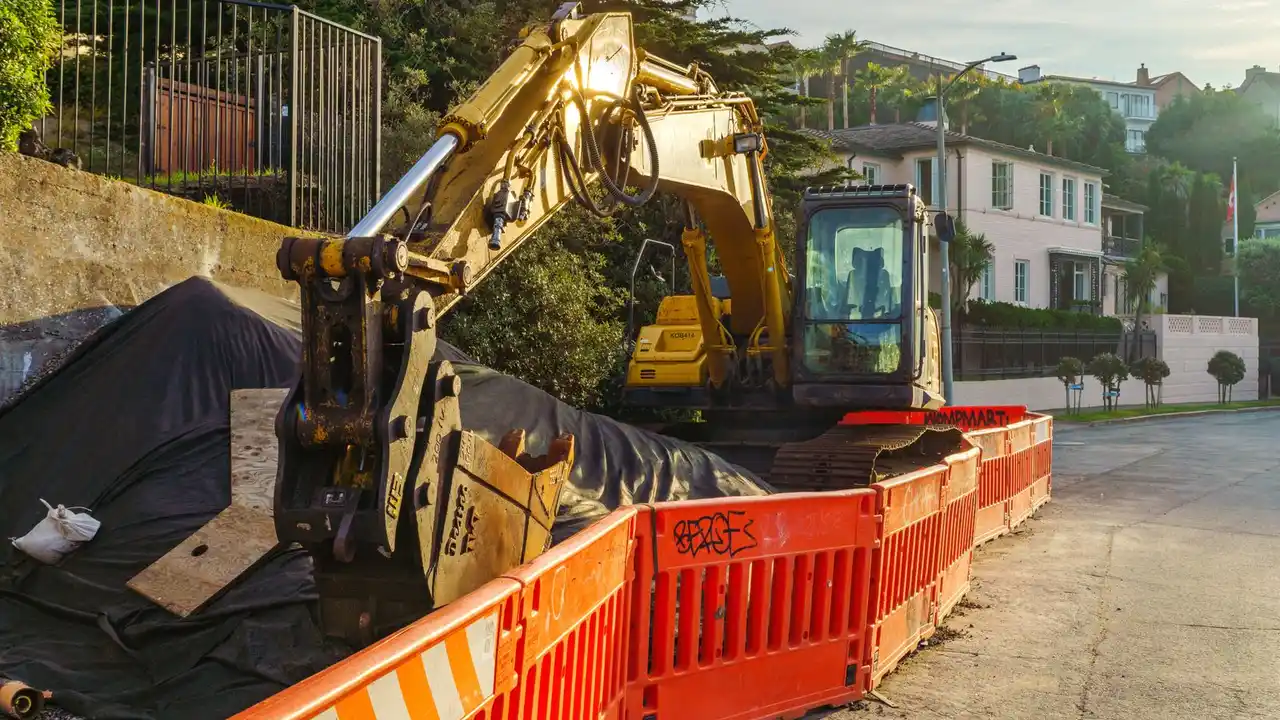
Traditional excavation vs trenchless repair for sewer and water line work
Traditional excavation opens the ground along the entire length of the pipe, while trenchless repair works from small access points at each end to replace or rehabilitate the same pipe. The right choice depends on the pipe's material, the type of failure, how deep it sits, what is above it, and whether the line can be pulled or lined in place. You can read more on our blog.
Both methods restore flow and stop leaks. The difference is how much ground gets disturbed, how long the surface takes to recover, and whether the pipe's condition allows a trenchless approach at all.
What excavation-based repair actually involves for underground pipe work
Excavation-based repair, also called open-cut or traditional digging, removes the soil above the pipe so the line can be worked on directly. A crew marks the route, cuts the surface, digs a trench down to the pipe, exposes the failed section, and replaces or repairs it before backfilling and restoring the surface.
The trench has to be wide enough for a person to work in and long enough to reach sound pipe on both sides of the problem. That is why open-cut work disturbs more ground than the failed section alone: the repair needs clean pipe to connect to, and the trench follows the line until it finds it.
Excavation handles almost any failure. A collapsed pipe, a line crushed by roots, a section that has bellied or lost its slope, or a pipe that is broken in several places can all be cut out and replaced. It also lets the crew see the surrounding soil, which matters when the problem is not just the pipe but what is happening around it.
The trade-off is surface damage. Lawns, driveways, sidewalks, and landscaping along the route are opened, and the trench has to be backfilled and compacted correctly or the ground settles later. In slab-on-grade homes, an interior line under the slab is a different problem again, because the slab itself has to be opened and repaired.
How trenchless repair reaches the same pipe without a trench
Trenchless repair replaces or rehabilitates a pipe through small access pits at each end, so the ground between them stays closed. The two most common approaches are pipe bursting, which pulls a new pipe through the old one while breaking the old pipe outward, and lining, which installs a resin-saturated liner inside the existing pipe to form a new inner wall.
Pipe bursting keeps the same route and can often upsize the pipe, which matters when the old line was undersized. Lining keeps the existing pipe as a host and seals cracks, joints, and small gaps, but it does not fix a pipe that has lost its shape or its slope. Both methods need a continuous, open path for the tooling or the liner to travel.
Trenchless work depends on access. The pits have to reach the pipe at both ends, and the pipe has to be clear enough to pass tooling or a liner through. A line that is collapsed, offset, or blocked by heavy root intrusion may not accept a trenchless method without first being opened and cleared, which can push the job back toward excavation.
Trenchless methods are not new or experimental. They are established repair techniques with their own limits, and the limits are what decide whether they fit a given line. When they fit, the surface above the pipe is largely untouched.
Open-cut digging versus trenchless methods: a side-by-side comparison
Open-cut digging and trenchless repair differ most in surface disturbance, access needs, and the range of failures each can address. The table below compares them on the factors that usually decide the method.
| Factor | Open-cut excavation | Trenchless repair | |---|---|---| | Ground opened | Full length of the repair | Small access pits at each end | | Surface restoration | Lawn, driveway, or slab repair along the route | Minimal, mostly at the pits | | Pipe condition needed | Any condition | Pipe must allow tooling or a liner through | | Common uses | Collapsed, crushed, offset, or bellied pipe | Cracked, jointed, root-intruded, or aging pipe | | Depth sensitivity | Deeper trenches cost more and disturb more | Depth matters less to surface damage | | Slope correction | Can reset slope | Generally cannot correct slope | | Access | Needs open ground along the route | Needs reachable ends |
Neither column wins on its own. A shallow line under bare dirt may be simpler to open than to set up for trenchless work, while a deep line under a finished driveway usually favors trenchless. The comparison is a starting point, not a verdict.
The method also affects the schedule. Open-cut work includes digging, pipe work, backfill, compaction, and surface repair, so the surface phase can run after the pipe is already fixed. Trenchless work front-loads the setup and then moves quickly along the pipe, but it can stall if the pipe will not accept the tooling.
What soil, depth, and surface conditions decide the method
Soil, depth, and what sits above the pipe decide which method is practical before pipe condition is even considered. Loose or sandy soil is easier to dig and easier to compact, while caliche, rock, or heavily compacted ground slows open-cut work and can make trenchless access pits harder to dig.
Depth changes the cost and risk of open-cut work more than it changes trenchless work. A shallow line is a modest trench; a deep line means shoring, more spoil to remove, and a larger surface scar. Trenchless methods still need to reach the pipe at the pits, but the disturbance between the pits does not grow with depth.
The surface above the pipe often decides the method on its own. A line under a mature tree, a paver patio, a finished driveway, or established landscaping is expensive and slow to restore, which favors trenchless where the pipe allows it. A line under bare soil or a gravel strip may be simpler to open.
Access is the other half of the decision. Trenchless repair needs a reachable point at each end of the run, and a line that dead-ends under a structure or runs beneath a slab may not offer one. When access is limited, open-cut work may be the only route, even if it disturbs more, so contact us to assess it.
How each approach affects driveways, lawns, and established landscaping
Open-cut work removes and restores the surface along the entire repair, while trenchless work leaves almost all of it in place. That difference is usually the homeowner's main concern, because a lawn recovers on its own but concrete, pavers, and mature plantings do not.
A trench through a lawn leaves a strip that has to be backfilled, compacted, and reseeded or re-sodded. If the backfill settles, the strip sinks and has to be topped up. A trench through a driveway or sidewalk means cutting and replacing concrete, and the new section rarely matches the old one exactly.
Mature trees are a separate risk. Open-cut work cuts roots along the trench line, and cutting major roots can destabilize a tree over time. Trenchless work avoids that root damage along the run, which is one reason it is often chosen when a line passes near established trees.
Trenchless work is not surface-free. The access pits still open the ground at each end, and those pits can land in a lawn, a driveway, or a planting bed depending on where the pipe is reachable. The disturbance is smaller and more localized, not absent.
Pipe material and failure type: what each method can and cannot fix
Pipe material and the type of failure set the hard limits on which method will work. Clay tile, cast iron, galvanized steel, copper, PVC, and PEX all behave differently, and each fails in its own way.
Clay tile and cast iron are common in older housing stock. Clay cracks and shifts at the joints, and roots enter through those joints. Cast iron corrodes and scales internally until the bore narrows and the pipe eventually fails. Both can often be lined or burst where the pipe still has a continuous path.
A collapsed or crushed pipe is the clearest case for open-cut work. Once the pipe has lost its shape, tooling and liners cannot pass, and the failed section has to be removed. The same is true for a line that has bellied or lost its slope, because trenchless methods generally cannot reset grade.
A cracked but still round pipe, a pipe with root intrusion at the joints, or an aging pipe that is otherwise intact are the cases where trenchless repair fits best. The failure is in the wall or the joints, not in the pipe's shape or path, so a liner or a burst replacement can address it without opening the ground.
Water supply lines versus sewer and drainage lines: why the choice differs
Water supply lines and sewer or drainage lines are different systems, and the repair choice differs because of what each one carries and how it fails. A water supply system carries pressurized water into the home, while a drainage system and sewer system carry waste away by gravity. Our sewer repair service covers the drainage side.
Pressure changes the repair. A water line leak is often a pinhole or a joint failure under pressure, and the pipe is smaller and usually deeper than a sewer lateral. Trenchless repair for water lines exists, but the smaller diameter and the need to restore full pressure capacity narrow the options compared with our sewer services.
Gravity changes the sewer side. A sewer line has to hold its slope from the house to the main, so a repair that cannot correct grade is limited to failures that did not change the slope. A sagging or bellied sewer line is a grade problem, and grade problems usually mean open-cut work.
The two systems also fail at different rates and for different reasons. Water lines fail from pressure, corrosion, and mineral scale, while sewer lines fail from root intrusion, ground movement, and the corrosive nature of what they carry. The failure mode, not the pipe material alone, is what points to the method.
Restoring flow, pressure, and drainage after the repair is complete
After the pipe is repaired, the line has to be tested and the system has to be returned to normal flow, pressure, and drainage. A repair that restores the pipe but leaves debris, air, or a partial blockage in the line is not finished.
On a water line, the crew restores pressure and checks for leaks at the new connections and along the repaired run. Trapped air is purged, and fixtures are checked for consistent pressure. A pressure drop after the repair points to a remaining restriction or a connection that is not fully sealed.
On a sewer or drainage line, the crew confirms flow by running water through the line and checking that it drains at the expected rate. A camera inspection after the repair shows whether the new pipe or liner is seated correctly and whether any debris was left behind.
Surface restoration is the last step in open-cut work. The trench is backfilled in lifts and compacted so it does not settle, and the surface is restored to match what was there. Skipping compaction is a common cause of a sunken strip months later.
How hard water, water softeners, and treatment systems influence pipe longevity
Hard water leaves mineral scale inside pipes, and scale narrows the bore, raises pressure losses, and shortens the life of the pipe and the fixtures it feeds. Water in this region commonly runs high in dissolved minerals, which is why scale is a routine finding rather than an occasional one.
Scale builds where water sits or moves slowly. It coats the inside of supply lines, water heater tanks, and fixture aerators, and it can eventually restrict flow enough to look like a pressure problem. A water heater full of scale heats less efficiently and fails sooner than one that is not.
A water softener removes the minerals that form scale, which reduces how fast scale builds inside the pipes and the water heater. A softener does not repair existing scale, and it does not change the pipe's material or age, so it slows the problem rather than reversing it.
Water treatment systems address water quality more broadly, and their effect on pipe longevity depends on what they remove. A treatment system that reduces scale-forming minerals helps the same way a softener does, while one aimed at other water quality issues may not change scale at all. The pipe's material and the water's chemistry together decide how fast it degrades.
Reading the warning signs: leaks, clogs, and when a line needs attention
A leak, a recurring clog, or a drop in pressure is the signal that a line needs attention, and the pattern of the symptom points to where the problem is. A single clog that clears and stays clear is usually a local blockage, while clogs that return in the same place point to a defect in the pipe.
A wet patch in the yard, a meter that keeps moving with everything off, or a drop in water pressure at the fixtures can indicate a water line leak. On the drainage side, slow drains throughout the house, gurgling, or sewage odor suggest a problem in the main line rather than a single fixture.
Mineral scale and root intrusion produce different patterns. Scale builds gradually, so pressure and flow decline slowly over time. Root intrusion is seasonal and recurring, because roots grow back into the same joint after each clearing.
The warning signs matter because they decide how much of the line is involved. A single failed joint is a small repair, while a line that fails in several places or has lost its slope is a larger job. Catching the pattern early is what keeps a small repair from becoming a full replacement.
Limits, risks, and long-term performance of each method
Each method has limits, and the limits are what determine long-term performance. Open-cut work replaces the failed section with new pipe, so the repaired section performs like new pipe, but the rest of the line is unchanged and can fail later.
Trenchless lining leaves the old pipe in place as a host, so the liner's performance depends on the host pipe staying intact. If the old pipe continues to shift or corrode around the liner, the liner can be affected. Pipe bursting replaces the pipe along the run, which addresses the pipe itself but still depends on the access pits and the surrounding soil.
Both methods can fail if the underlying cause is not addressed. A line that failed from root intrusion will fail again if roots keep entering, and a line that failed from ground movement will fail again if the ground keeps moving. The repair fixes the pipe; it does not change the conditions that damaged it.
Long-term performance also depends on what the line carries. A sewer line that handles grease, wipes, or heavy solids will clog again regardless of how well it was repaired. A water line in hard water will scale again unless the water is treated. The repair restores the pipe, and maintenance decides how long it lasts.
How a plumber evaluates a line and explains the options
A plumber evaluates a line by locating it, inspecting its condition, and identifying the failure before recommending a method. The evaluation starts with the symptoms the homeowner describes and the location of the line, then moves to direct inspection.
A camera inspection is the main tool for sewer and drainage lines. It shows the pipe's material, its condition, where it has cracked or shifted, and whether roots or debris are present. For water lines, leak detection narrows down where the line is losing water before any digging starts.
The evaluation also considers what is above the pipe and how deep it sits, because those factors decide how much surface would be disturbed. A plumber weighs the pipe's condition against the access, the surface, and the failure type to decide whether trenchless repair is possible or whether open-cut work is needed.
The explanation should cover what was found, what each method would involve, and what each one would and would not fix. If the pipe cannot accept a trenchless method, that is part of the explanation, not a reason to avoid the conversation. The homeowner should leave knowing why one method fits and the other does not.
Common questions about traditional excavation vs trenchless repair for sewer and water line work
What is traditional excavation vs trenchless repair for sewer and water line?
Traditional excavation opens the ground along the pipe to replace or repair it directly, while trenchless repair works through small access pits to replace or line the pipe in place. The difference is how much ground is opened, not whether the pipe gets fixed.
How does traditional excavation vs trenchless repair for sewer and water line work?
Open-cut work digs a trench down to the pipe, replaces the failed section, and restores the surface, while trenchless work pulls a new pipe through the old one or installs a liner inside it. Trenchless work needs a continuous path and reachable ends, which is why a collapsed or offset pipe usually cannot use it.
What should I know about traditional excavation vs trenchless repair for sewer and water line?
The pipe's condition, depth, and what sits above it decide the method more than cost does. A cracked but round pipe under a finished driveway usually favors trenchless, while a collapsed, crushed, or sagging pipe usually requires open-cut work because trenchless methods cannot correct shape or slope.
What trenchless methods are available for sewer and water line repair, and when are they appropriate?
Pipe bursting and lining are the two common trenchless methods, and they fit pipes that are still round and continuous enough to accept tooling or a liner. They are appropriate when the failure is in the pipe wall or joints and the pipe's path and slope are intact.