
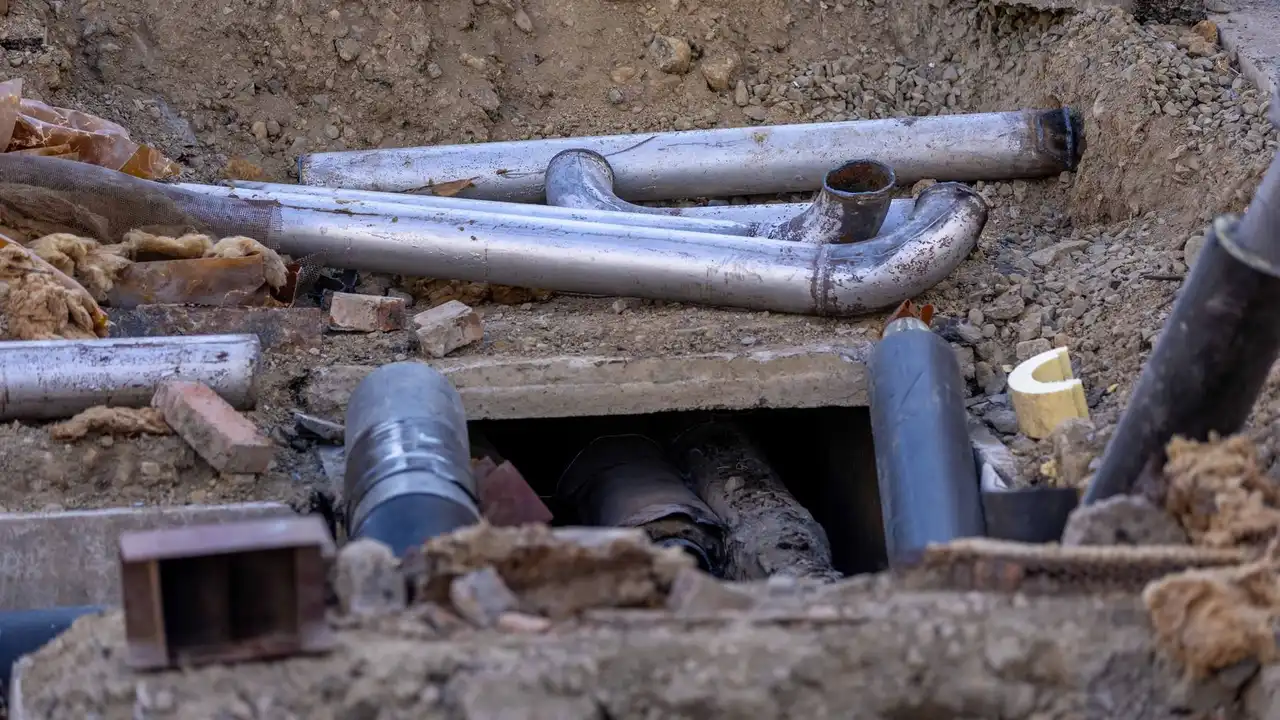
What trenchless methods are available for sewer and water line repair, and when are they appropriate?
The main trenchless methods for sewer and water line repair are cured-in-place pipe lining (CIPP), pipe bursting, sliplining, horizontal directional drilling, pipe reaming, and fold-and-form. Trenchless repair is appropriate when the pipe still has enough structural integrity to host or receive a new pipe, when the defect is localized or the run is accessible from small entry pits, and when open-cut excavation would damage driveways, mature landscaping, or slab-on-grade floors.
Trenchless technology repairs buried pipes without continuous trenching. Instead of digging a long open trench, a plumber works from small entry pits at each end or through existing manholes, so the yard, driveway, and hardscape stay largely intact. Whether a specific method fits depends on the pipe material, its diameter, the type of defect, and how much the pipe has settled or collapsed. You can read more on our blog.
What trenchless repair actually means for buried pipes
Trenchless repair means fixing or replacing a buried pipe with minimal digging, using small entry pits at each end or existing manholes as access points. A plumber who performs trenchless work does not cut a continuous trench along the whole run; instead, the equipment enters the pipe and either rebuilds it from within or pulls a new pipe through the old path.
The access requirement is the defining feature. Trenchless methods need a small pit at each end, or a manhole, so the equipment can be inserted and the new liner or pipe can be pulled through. That is why trenchless work avoids damage to landscaping and driveways: the surface between the two pits is left alone.
For a homeowner, the practical difference is disruption. Open-cut excavation removes the soil above the pipe for the full length of the repair, which can mean removing concrete, fencing, or mature trees. Trenchless repair keeps that surface intact, but it is not always possible, and the pipe itself has to meet certain conditions.
Why underground pipe failure happens in the first place
Underground pipe failure happens because of age, soil movement, root intrusion, corrosion, and mineral scale, and the mix of those causes decides which repair method will work. A sewer line and a water line fail in different ways, even when they run through the same soil.
Sewer lines commonly develop cracks, root intrusion, offset joints, corrosion, and bellies, which are low spots where waste and water collect. Tree roots enter through small cracks and joints, then expand and block flow. Offset joints happen when the soil shifts and the pipe sections no longer line up, which catches debris and causes recurring clogs. Corrosion thins the pipe wall from the inside, especially in older cast iron and clay pipe.
Water lines commonly develop leaks, corrosion, pinhole leaks, and joint failures. Hard water with 15 to 25 or more grains per gallon leaves mineral scale inside the pipe, which narrows the opening and raises pressure. That pressure finds weak points, and pinhole leaks form where the metal has thinned. A water leak can run for a long time before it shows at the surface, which is why leak detection often comes before any repair decision.
The housing context matters too. Single-story, slab-on-grade construction, older housing stock, and mature landscaping all change what a repair will disturb. A pipe under a mature tree or a concrete slab is a strong candidate for a no-dig repair, provided the pipe itself can take it.
The main trenchless methods used on sewer and water lines
The main trenchless methods are cured-in-place pipe lining, pipe bursting, sliplining, horizontal directional drilling, pipe reaming, and fold-and-form. Each one solves a different problem, and the choice comes down to pipe material, diameter, defect type, and how much the pipe has deformed.
Cured-in-place pipe lining rebuilds the existing pipe from the inside with a resin-saturated liner that is cured in place. Pipe bursting pulls a bursting head through the old pipe to break it outward while pulling new pipe into the same path, and it can increase the diameter. Sliplining inserts a new, slightly smaller pipe inside the old one. Horizontal directional drilling drills a new path for pipe installation, which is useful for new runs and long replacements. Pipe reaming grinds away the old pipe while pulling new pipe through. Fold-and-form folds a liner, inserts it, then expands it against the host pipe.
These methods share the same access requirement: small entry pits at each end or existing manholes. They differ in what they do to the old pipe. Lining and sliplining leave the old pipe in place as a host. Bursting and reaming destroy or remove it. Directional drilling ignores the old path and creates a new one.
Cured-in-place pipe lining and how it rebuilds a pipe from within
Cured-in-place pipe lining, often called CIPP, restores structural integrity from within by inserting a resin-saturated liner into the existing pipe and curing it until it hardens into a new pipe wall. The old pipe stays where it is and acts as a host; the liner becomes the new flow surface.
CIPP is usually chosen for sewer lines with cracks, root intrusion, offset joints, or corrosion where the pipe has not collapsed. It works on clay, cast iron, PVC, concrete, and other common sewer materials. The curing method can be steam cured, hot water cured, or UV light cured, and the choice depends on the liner and the site conditions. It is one of the sewer services we provide.
The result is a smooth, jointless interior that resists root intrusion because there are no joints for roots to enter. Typical lifespan is often cited in the range of 50 years, though that depends on installation quality, the resin used, and what the pipe carries. CIPP does reduce the inside diameter slightly, which matters on a line that is already undersized or heavily scaled.
Pipe bursting and when replacing a line beats repairing it
Pipe bursting replaces old pipe by pulling a bursting head through it to break it outward while pulling new pipe into the same path, and it is appropriate when the old pipe is too far gone to line. A collapsed or badly deformed pipe cannot host a liner, but it can often be burst and replaced.
Pipe bursting can increase the diameter. The new pipe can be the same diameter, one size larger, or up to two sizes larger, depending on the soil and the bursting head. That makes it useful when a line needs more capacity, not just a new wall.
Pipe bursting suits clay, cast iron, PVC, concrete, and other brittle materials that break cleanly. It does not suit every situation: nearby utilities, root masses, and soil conditions can limit it, and the entry pits still have to be dug. When the goal is replacement rather than repair, pipe bursting often beats lining because it gives the homeowner a genuinely new pipe rather than a liner inside an old one.
Sliplining and the role of the host pipe in the decision
Sliplining inserts a new pipe inside the old one, so the host pipe has to be sound enough to hold the new pipe and straight enough to pass it through. The new pipe is pulled or pushed into the host, and the space between them is often grouted.
Sliplining reduces the inside diameter, typically by 10 percent to 25 percent, or about one nominal size smaller. That reduction is the main trade-off. On a sewer line that is already near capacity, or a water line where flow matters, the smaller bore can be a problem. On a line with plenty of capacity, it is a straightforward repair.
Sliplining works on many pipe materials, including clay, cast iron, PVC, and concrete. It is often chosen when the host pipe has lost wall thickness but has not deformed, because the host still provides a straight path. If the host pipe has offset joints or a belly, sliplining may not pass, and another method is needed.
Horizontal directional drilling for new runs and long replacements
Horizontal directional drilling drills a new path for pipe installation, so it is used for new runs and long replacements rather than for repairing a single defect. A steerable drill head creates a bore under the surface, and the new pipe is pulled through it.
Directional drilling is chosen when the old pipe cannot be used as a host or a path, or when the run is long and open-cut excavation would be too disruptive. Typical lengths run from 300 to 600 feet, and in some conditions up to 1000 feet. The method avoids damage to landscaping, driveways, and other surface features because the bore passes beneath them.
Directional drilling suits new water line installation and long sewer replacements. It needs a launch pit and a receiving pit, and it depends on soil conditions and the presence of other utilities. It is not a repair method for a single crack; it is a way to install a new line where the old one cannot be saved. For the repair side of the work, see our sewer repair service.
Pipe reaming, fold-and-form, and other less common trenchless options
Pipe reaming and fold-and-form are less common trenchless options that solve specific problems the main methods do not. Pipe reaming grinds away old pipe while pulling new pipe through, which is useful when the old pipe is brittle and the new pipe needs to be the same size or larger. Fold-and-form folds a liner, inserts it, then expands it against the host pipe, which can help where access is tight.
Pipe reaming is often used on brittle materials that can be ground away without collapsing the bore. It combines removal and replacement in one pass. Fold-and-form is a lining variant: the liner is deformed to a smaller profile for insertion, then expanded and cured against the host. It is chosen when a standard CIPP liner cannot be inserted easily.
These methods are not the first choice for most residential sewer and water lines, but they matter when the common methods do not fit. A plumber who offers trenchless repair should be able to explain why one of these is being considered instead of CIPP, bursting, or sliplining.
How a method is chosen for a sewer line versus a water line
A method is chosen by matching the pipe material, diameter, defect type, and access to the method that can handle them, and sewer lines and water lines are assessed differently. A sewer line carries waste by gravity, so slope and flow matter. A water line carries water under pressure, so joint integrity and pressure testing matter.
For a sewer line, a camera inspection shows where the pipe has cracked, where roots have entered, and whether the pipe has a belly or offset joints. CIPP and sliplining are common when the pipe can host a liner. Pipe bursting is common when the pipe is collapsed or needs more capacity. Directional drilling is common for long replacements where the old path cannot be used.
For a water line, leak detection and pressure testing come first, because a water line leak can be hidden. CIPP is less common on pressure lines than on gravity sewers, and methods like pipe bursting, sliplining, and directional drilling are used for water line replacement. The pipe material matters: copper, PVC, and HDPE each behave differently under each method, and the wrong match can fail.
Pipe diameter narrows the options. Trenchless methods generally cover a range from about 2 inches to 48 inches, with common residential work in the 4-inch to 24-inch range and larger sewer work up to 36 inches. A line outside the workable range for a given method needs a different approach.
Conditions that rule trenchless work out and open-cut digging in
Open-cut excavation is necessary when the pipe has collapsed so badly that it cannot host or pass a liner, when the run has severe bellies or multiple offset joints, when access pits cannot be dug, or when the soil and nearby utilities make trenchless equipment unsafe to use. Trenchless repair is not a universal answer, and a plumber who says it is should be questioned.
A collapsed sewer pipe can sometimes be fixed trenchlessly, but not always. If the collapse is localized and the rest of the pipe is sound, a spot repair or a short liner may work. If the pipe has lost its shape over a long section, pipe bursting or open-cut replacement is more likely. The camera inspection is what tells the difference.
Not every pipe material suits every method. Clay and cast iron break well for pipe bursting, but a heavily corroded pipe may not hold a liner. PVC and HDPE behave differently under bursting and reaming. Copper water lines are usually replaced rather than lined. The material, diameter, and condition together decide whether trenchless work is appropriate.
Surface conditions also matter. A pipe under a concrete slab, a driveway, or mature landscaping is a strong candidate for trenchless work because open-cut digging would be expensive and disruptive. A pipe in open soil with no surface obstructions may be simpler to open-cut, especially if the repair is short.
What homeowners should understand about limits, lifespan, and verification
Trenchless repair has limits, a lifespan that depends on the method and installation, and a verification step that confirms the work before the pits are closed. Understanding those three things helps a homeowner judge whether a recommendation makes sense.
Lifespan varies by method. CIPP liners are often cited in the range of 50 years, and some trenchless repairs are cited up to 50 to 100 years, but those figures depend on the resin, the pipe, the soil, and what the line carries. No method lasts forever, and a repair that is appropriate today may still need attention later.
Verification is what separates a proper job from a guess. A sewer camera inspection confirms the liner is smooth and fully expanded, with no gaps or wrinkles. Pressure testing confirms a water line holds pressure. Flow testing confirms the line drains as it should. A homeowner should ask how the work will be verified before the pits are backfilled.
What a homeowner can safely do is limited. You can note slow drains, gurgling, damp spots in the yard, unexplained increases in water use, and recurring clogs, and you can write down when they started. You should not dig around a buried sewer or water line, open a sewer cleanout under pressure, or attempt to rod a line that may be collapsed, because those actions can damage the pipe or cause injury. A camera inspection is the safe way to find out what is happening, and it is the step that tells you whether trenchless repair is even an option.
When the line is collapsed, when the leak is under a slab, when the water line will not hold pressure, or when gas plumbing is involved, the job needs a licensed professional. Sewer and water line work is regulated, often permitted, and requires the right equipment and insurance. A plumber with a master plumber on staff can assess the pipe, recommend a method, and verify the result, so contact us to get started.
Related questions
What trenchless methods are available for sewer and water line repair, and when are they appropriate?
The methods are cured-in-place pipe lining, pipe bursting, sliplining, horizontal directional drilling, pipe reaming, and fold-and-form. They are appropriate when the pipe can host or receive a new pipe, when access pits can be dug, and when open-cut digging would damage hardscape or landscaping.
What is trenchless methods are available for sewer and water line repair, when they appropriate?
It means repairing or replacing a buried pipe with minimal digging, using small entry pits or existing manholes. The method is appropriate when the pipe material, diameter, and defect type match what the method can handle.
How does what trenchless methods are available for sewer and water line repair, when they appropriate work?
A plumber inserts equipment through a small entry pit or manhole and either rebuilds the pipe from within, pulls a new pipe through the old path, or drills a new path. The surface between the pits is left undisturbed.
What should I know about trenchless methods are available for sewer and water line repair, when they appropriate?
Know that trenchless repair is not universal. A collapsed pipe, severe bellies, or poor access can rule it out, and verification by camera, pressure testing, or flow testing confirms the work before the pits are closed.